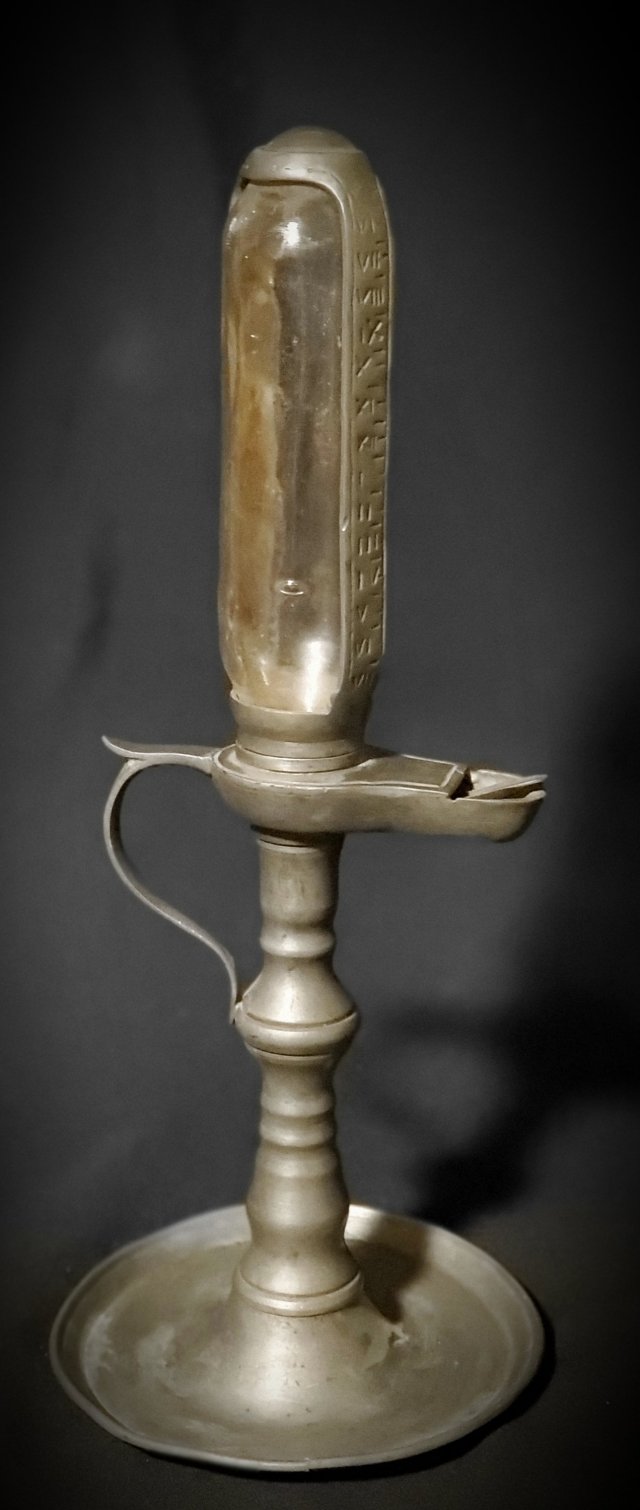
There’s not much information available for these strange-looking oil lamps. Fashioned from pewter with a candlestick shape, these lamps held a glass ampoule that would’ve been filled with whale oil. As the whale oil burned at a consistent rate, the time could be read by the markings etched into the pewter that held the glass. These lamps were produced during the 18th and early 19th centuries. What specific purpose did these lamps serve?
There were many options for keeping track of time when the 18th century was in full swing. The first mechanical clocks were invented in Europe in the 14th century, followed by pendulum clocks in the mid 17th century. Pendulum clocks were the most accurate timekeeping devices up until the 20th century. The first portable/wearable clocks weren’t available until the 16th century and were not very accurate, however, and could gain as much as an hour a day or more. It wasn’t until the mid 17th century that they were improved upon and could keep time with more accuracy. Pocket watches were available, but considered a luxury item for the elite until the very end of the 18th century.
So at the time the oil lamp clock was made there are pendulum clocks (from grandfather size down to desktop size) and pocket watches (if you had the money). An oil lamp clock would be both portable and more affordable for someone in the mid to late 18th century.
One thing to note about the oil lamp is the numbering of the roman numerals on the side. Starting at 6 and ending at 7, it would seem that the numbers count the evening hours until sunrise. The light from the wick would’ve illuminated the roman numerals and the ampoule in the darkness. Doesn’t seem to be very useful in a household setting.
These functions would be useful for a ship’s navigator relying on the stars to plot his course. In order to calculate longitude while out of sight of land, it is necessary to have a time standard. The rolling of the ocean rendered the accurate pendulum clocks useless. The first accurate marine chronometer wasn’t invented until the latter half of the 18th century. Pocket watches were extremely expensive. That leaves oil lamp clocks, with the steady burning of the whale oil. The light they gave off would’ve been useful for reading charts. More than likely this was a ship’s tool to help navigate by the moon and stars.
The use of whale oil as an illuminant has a very short period of use from the mid 1800s to the late 19th century, when it was replaced by kerosene. That makes these lamps somewhat hard to find. I was lucky enough to pick one up on Ebay a while back, but I’ve yet to see them in an antiques shop.
 Ella's Heirlooms